
Homa Therapy Cultural Event in Peru June 2026 Satsang | Volume 54 # 2| New Era 83
Homa Therapy Cultural Event in Peru
Abel Hernandez and Aleta Macan
Piura, Peru|
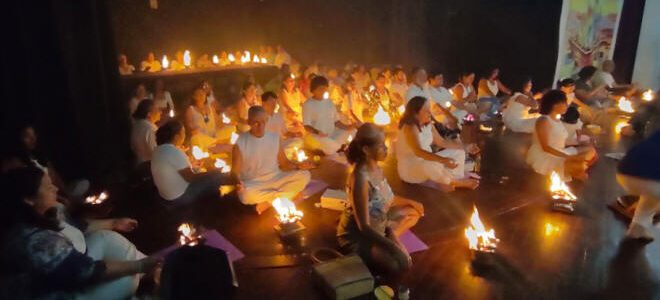
 On May 23, 2026, the long-awaited day of the Homa Therapy Cultural Event finally arrived. It had been two very busy weeks of intense preparation by the various committees made up of Agnihotris, who offered their help, creativity, expertise, time, talent, transportation, money, and above all, their love and dedication to ensure this would be an event filled with Light and Joy that would attract more people interested in the revival of this ancient healing technique.
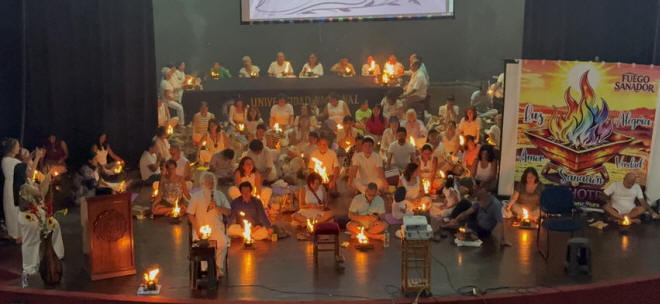
The main auditorium at the National University of Piura looked beautiful, decorated with flowers, a giant poster, and more than a hundred paintings of pyramids, lovingly done and strung along both sides of the auditorium. The entire recording and audio system was set up, along with a small Homa stand, etc., and the Agnihotris were ready to welcome everyone–an excellent example of teamwork.
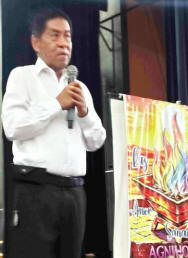
The University’s Rector, Dr. Adolfo Zeta, opened this beautiful event and welcomed the entire audience; some participants had come from Quito, Ecuador, others from Lima, Chiclayo, Jaén, Arequipa, and even as far as Pucallpa. Dr. Zeta also shared his personal testimony about Agnihotra, which provided him with relief from his glaucoma from the very first day, in addition to helping him relax from his stressful job. He began practicing Agnihotra a month and a half ago.
Also in attendance was the beautiful dance troupe from the university. The instructor of these professional dancers is Professor Javier Tejada Bravo, and they enchanted the audience with a Paraguayan Galopera dance and the San Juanito dance from Ecuador. They amazed everyone with their creativity and beauty in this art of folkloric expression!
Singer and Agnihotri Julia Yépez, accompanied by her musical partner Noel Adrianzen Palacios on the accordion, delighted the audience with folk songs from the Southern Highlands of Peru.
Fourteen-year-old Blanca Milena Ojeda came with her mother from Tambogrande, to enchant us all with a traditional Peruvian dance, the “Marinera María Teresa.” What’s amazing is that when she dances, every cell in her body comes alive, and it seems as though she’s no longer touching the ground—rather, the energy of the music expresses itself through her.
Amid the beautiful cultural performances and songs, there were live testimonials from several Agnihotris—some of whom have been practicing Homa Therapy for 20 years or more—as well as testimonials from people who are new to the healing fires. These testimonials conveyed to the audience the healing power of this ancient practice for a wide range of issues:
– physical (such as tumors, asthma, Parkinson’s disease, sinusitis, hemorrhoids, cirrhosis, side effects of vaccines, etc.)
– emotional and mental (such as fear, anxiety, lack of motivation, suicidal thoughts, etc.)
– even neighborhood problems (such as drug use, red-light districts, etc.)
– On Homa farming, we heard from young Justinien from Pucallpa (Peruvian Amazon), whose parents, like him, had the honor of meeting Master Shree Vasant when He arrived there to introduce Homa Agricultural Therapy, and who witnessed the eradication of the plant disease Black Sigatoka in banana crops—something that cannot be achieved with any chemical.
These Agnihotris now have nothing but words of GRATITUDE for Homa Therapy for filling their lives with health, light, love, tranquility, happiness, and joy, and for the guidance and peace they can enjoy in their lives through the practice of this simple technique.
Short videos were shown and explanations provided on how Agnihotra works and how to practice this ancient technique correctly to maximize its benefits.
 Of course, the event wouldn’t have been complete without Javier Cruz’s guitar and devotional songs, accompanied by the powerful voices of Yusefa, Alena, and Judith. The lyrics were projected so that everyone could sing along.
Then it was time to rehearse the sunset Mantras, set up the stage with the pyramids, and get ready to receive the last rays of the sun, which would flood everyone present with peace and healing.
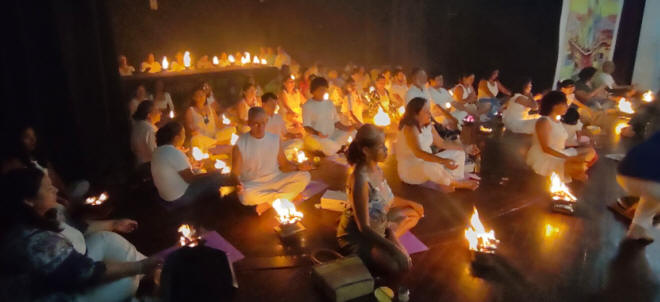 At sunset, more than 80 Agnihotris lit their Fire of LOVE, with the Joy of being able to share
healing, peace, and deep well-being.
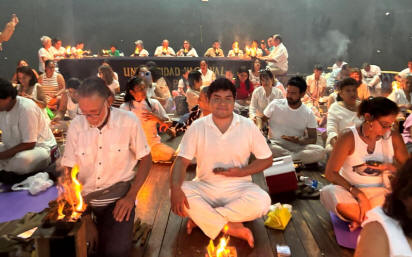 As the many healing fires were slowly extinguishing, leaving the atmosphere with a palpable sense of peace, open hearts filled with happiness, and an ambiance of pure love, Marisol Carrión gently played Pachelbel’s Canon in D Major as a solo on the guitar… what a wonderful experience!
At the end, everyone received a small packet of powdered Agnihotra healing ash, along with instructions on how to take it and an invitation to the Homa Centers in Piura.Words fall short in describing the STRENGTH that arises from being and acting in UNITY! We left with hearts full of gratitude and peaceful minds, witnessing this newfound joy brought about by the Fires of Homa Therapy.
THIS WAS ANOTHER UNFORGETTABLE EVENT OF DIVINE GRACE!
This ancient AGNIHOTRA technique is a gift to all of humanity! OM SHREE!
Chilean Reforestation Program with Homa
 Karina Ohme
Satsang Farm
Curacaví, Chile
In 2025, the reforestation program, “Honey-Producing Flora to Improve the Sustainability of the Beekeeping Business in the Metropolitan Region,” began in Chile. The project was implemented by the Chilean Forestry Institute (INFOR), a private-law corporation under the Ministry of Agriculture, and funded by the Regional Government of the Metropolitan Region. As a member of the Curacaví Organic Producers and owner of the Satsang farm in Curacaví, I was selected as one of the 32 beneficiaries of this reforestation program using native honey-producing species.
In general, the reforestation carried out by INFOR on all selected properties involved planting native trees using Basacote Plus (chemical fertilizer) as fertilizer and gel beads to retain water.
In the case of Satsang, I requested NOT to use these chemical products, but only Homa Efficient Microbiology for Native Forest (MicroBiHoma), which we produce on the farm, and Agnihotra Ash, to help restore the memory and vitality of the soil.
Planting Timeline
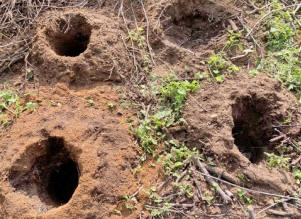 The planting holes, approximately 60 cm (24 inches) deep, were dug in June 2025 using the Miyawaki method. This method, developed by Japanese botanist Akira Miyawaki, creates dense, biodiverse native forests by mimicking natural ecosystems. In small spaces, various native species are planted, promoting rapid growth with minimal maintenance after the first two years.
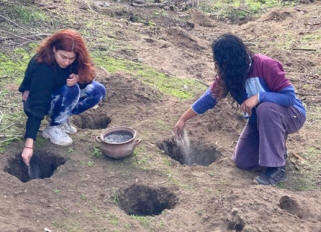 The second application of Agnihotra Ash inside the holes took place on July 27, 2025. To ensure that all holes contained Agnihotra ash, a handful was applied to each one again.
On August 8 and the following days, the native honey-producing trees were planted. The saplings brought by the INFOR team were very small, bare-rooted [dug from the ground, without any soil around their roots.-Ed.] I—they had grown in nurseries—and generally did not exceed 20 cm (8 inches) in height. The first ones planted were some that had been left over from another planting and had had their roots exposed for many days.
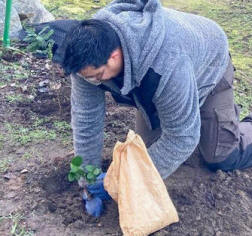 The holes they had previously dug had to be refilled because the seedlings were so small. When refilling the holes, we added solid MicroBiHoma—an Homa-based native forest microbial bio-stimulant that we produce here on the Satsang farm—to the soil at a rate of approximately 1 tablespoon per hole.
In addition, before planting the seedlings, they covered their roots with Agnihotra Ash. I am deeply grateful to the professionals on the team assigned by the Chilean Forestry Institute, who were very flexible and respectful in following all the instructions I provided.
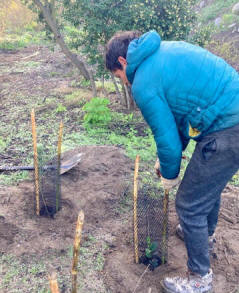 Once planted, the saplings were protected with plastic netting and coligüe sticks, specifically to keep rabbits away. In total, 340 native honey-producing species from Chile’s sclerophyllous forest were planted.
On October 27, as summer and the heat were already setting in in Chile, the drip irrigation system was installed. It is important to note that in the central region, we can experience extremely dry summers, with 7 to 8 months without rain.
On October 29, the directors of the Chilean Forestry Institute’s reforestation program paid a technical visit to the plot. During the visit, the forestry engineers were surprised by the existing forest at Satsang, the size of the leaves on some Boldos (an endemic medicinal tree of Chile), and the Tata, a century-old Quillay tree.
In addition, they saw firsthand how we produce MicroBiHoma and apply Homa agricultural technology. The director of the reforestation program attributed the remarkable condition of the forest on the farm to the practices we employ and expressed interest in conducting further research.
On November 5, 2025, we performed the first drip irrigation, and starting on November 17, we began watering twice a week.
On November 21, we applied liquid MicroBiHoma to 50 saplings located in the driest part of the plot.
On December 7 and again on January 5, we added a handful of Agnihotra Ash around the saplings. In addition, in January and February, we placed layers of grass, weeds, and vegetable leaves that we removed from the garden to protect the soil around the saplings and to ensure that the rabbits ate those leaves instead of the saplings.
On the afternoon of March 2nd 2026, we buried one tablespoon of solid MicroBiHoma per sapling, near each dripper.
Given the excellent results that the forestry engineers observed in the reforestation project using Homa technology in Satsang, they asked us to organize a demonstration field day on the site, which took place on April 7th.
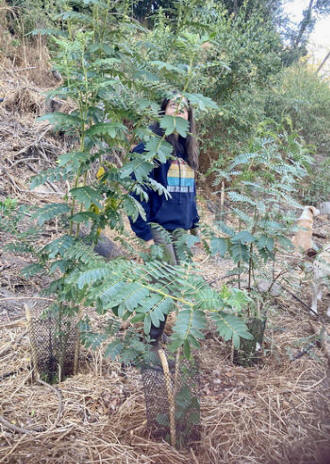
On this occasion, in addition to executives and professionals from the Forestry Institute, other program beneficiaries participated, and they were surprised by the height of the native species planted in Satsang.
Following this event, invitations have emerged to continue research and participate in conferences to present the reforestation experience in Satsang, using MicroBiHoma and Agnihotra Ash.
I hope this experience will help people understand the importance of caring for and restoring the life and memory of the soil, promoting agro-ecological agricultural and forestry practices that include, among other things, the incorporation of locally produced Homa Efficient Microbiology from Native Forests, tailored to the original forest of each area.
Furthermore, I believe it is essential to add a factor that is often forgotten or overlooked, because modern agriculture lacks the answers on how to achieve it: the importance of restoring and nourishing the atmosphere. To quote the late Bruce Johnson, approximately 70% of plant nutrition comes from the atmosphere. Therefore, nourishing and restoring it is essential for trees and plants to grow strong and healthy. That is why I believe it is so important to include the daily practice of Agnihotra in reforestation and ecosystem restoration programs; so that, in addition to reviving the soil, we can restore life as a whole.
Homa Therapy Experiences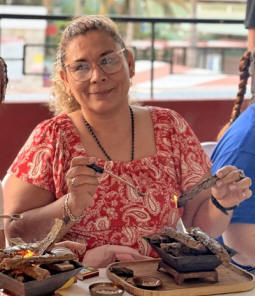
Judith Paredes Peña
Piura, Peru, South America
In 2022, I was involved in an accident at an oil well and inhaling the CO2. It damaged my esophagus and lungs, causing grade C esophagitis. (This means it is severe erosive esophagitis, where stomach acid has repeatedly refluxed into the esophagus, causing inflammation and multiple ulcers or lesions that spread). I also developed pulmonary fibrosis in both lung apices.
Then, over time, due to constant vomiting caused by esophageal irritation, my diaphragm dilated, and I developed a grade 4 hiatal hernia.
I was vomiting blood and passing blood in my stool. I was fed through a straw and was on a liquid diet. I received treatment that helped somewhat, but I got very tired, even from walking.
Since I began attending the Agnihotra Healing Fire as part of Homa Therapy, I can eat everything again, and my esophagus functions normally. My bowel movements are regular. I no longer suffer from constipation, and I get less tired.
These health problems began in 2022. I started treatment with Homa Therapy in January 2026; since then, I have felt a steady improvement.
Before I started Homa Therapy, I also had a lot of anxiety and a lot of depression. I was overweight. I weighed over 90 kilos (198 pounds).
After three weeks of attending Homa Therapy, I’ve noticed a huge improvement—a tremendous improvement—in my weight. I’ve lost at least 5 kilos (11 pounds) in 3 weeks, and I’ve regained my peace of mind. I’m no longer depressed, and I have greater mental clarity. The anxiety has stopped.
I also have a daughter who has lupus and only one kidney. She’s been taking Agnihotra ash and has experienced significant improvement. She’s stopped taking her medications and now only takes Agnihotra ash in the morning and at night. She’s sleeping well. She no longer has swelling, and the inflammation in her fingers has subsided.
Our whole family is taking Agnihotra ash mixed with juice or water twice a day.
 Juan Pablo Cortez
Bogota, Colombia, South America
I have been practicing Agnihotra for one year and two months. It has been a wonderful experience. I came with an addiction problem for which I had visited rehabilitation centers, psychologists, psychiatrists, and I had also sought help, so to speak, from churches and all that.
But the experience with the Agnihotra Fire has been amazing. It has been unique.
I can connect with myself, finding within what I have been searching for outside for a long time in a meaningless life. This connection helps me to stay in the present and be able to resolve certain situations. So, the Homa experience has been amazing, amazing, amazing.
From Shree Vasant’s Teachings
On Agnihotra Fire
Agnihotra fire, IF YOU REALLY WANT MAXIMUM EFFECT, should be prepared in such a way that there is a hole in the very center of the pyramid made by building the dung with ghee around it. It should be lit enough in advance so that the fire coming from the hole is burning freely with maximum energy. Then when we say the Mantra we hold the rice and ghee in Deer Mudra (Mrugi Mudra) with thumb between middle and ring fingers and index and small finger straight. Then from the heart, reach the had towards the fire and drop the rice in the hole, in the actual fire as we say, “swaha.” [This quotation is from Shree Vasant’s earlier writings. In subsequent writings and publications, He consistently said that we make the offering AFTER the word, “SWAHA.”-Ed.] This should only be done with the right hand. Right hand is giving energy; left hand is taking energy.
All the ingredients in the pyramid should be consumed by the fire; all should be ash. the fire should not be disturbed once it is lit, the Mantras are chanted and the rice is placed.
On Homa Farming
When planting is done, it should be done while Om Tryambakam Yajnya is going on the entire time and those who are planting can be chanting the Mantra.
The seed should only be planted with the right hand.
Also when soil is being prepared for planting, Agnihotra ash can, of course be mixed in but also Om Tryambakam Homa should go on continuously while the soil is being turned and prepared to receive the seed.
On Ghee
Clarified butter from cow’s milk is essential for any YAJNYA fires. YAJNYA is the technical term meaning the science of the purification of the atmosphere through the agency of fire as given through VEDAS. Vedas is the most ancient knowledge known to man.
The basic YAJNYA called Agnihotra is tuned to the biorhythm of sunrise/sunset. AGNIHOTRA reduces disease in an area, gives nourishment to crops and purifies the water resources.
Atmosphere has the capacity to retain and transmit sound plus transmit radio waves, satellite signals, etc., all types of communication without wires. Due to pollution this capacity will be affected to such an extent that signals shall get mixed and there will be chaos.
The substance called GHEE (clarified unsalted butter from cow’s milk) has the faculty of retaining in the atmosphere the impact of the solar spectrum. Thus the atmosphere gets richer with the energies and electricities that emanate from the sun. This, plus the sound of the Mantra that is retained by another faculty of GHEE in the atmosphere, makes it capable of recovering the correct vibration of energies that man must obtain when he breathes the atmosphere.
But the most important thing is that in the places where Fire is done, the sound current that will be sent will be attracted as a magnet by the pyramid and retained in the atmosphere by GHEE. GHEE is the essential substance to repair the tired atmosphere.
Let us keep a big stock of GHEE. Old GHEE automatically becomes medicinal.
We must create several places in which the atmosphere is saturated with GHEE and Mantras.
Let there be many HOMA farms where this is done automatically.
It is not a matter of belief. This is supertechnology that will save the planet.
Fivefold Path for Happy Living
1. Yajnya
HOMA Therapy is the science of purification of the atmosphere through the agency of FIRE. AGNIHOTRA HOMA (YAJNYA) is the basic HOMA. It is tuned to the biorhythm of sunrise/sunset and gives nutrients to the plant kingdom, removes diseases in a certain area and removes tension on the mind. This is the basic process in the Vedic sciences of medicine, agriculture, climate engineering and interplanetary communication.
2. Daan
Sharing of your assets in a spirit of humility. This corrects imbalance in financial matters and creates non-attachment to worldly possessions.
3. Tapa
Self-discipline of body and mind. This is conducive to a change in attitudes of mind and body. It results in a harmonious state of mind.
4. Karma
“You reap as you sow.” Always practicing good Karma (actions) diminishes the burden of negative Karma and one begins to invest in his own future. This means that what you do today will bring its fruits. Sowing seeds of love and kindness will bless my garden with plenty of love. Do Karma for self-purification.
5. Swadhyaya
Practice Swadhyaya (Self-study) for liberation. Who am I? Why am I here? My work on this planet is to learn to react with total LOVE with each opportunity given to me.
This is the Fivefold Path for happy living on the planet. By practicing the Fivefold Path you become better members of your society, group, religion, community, etc.
Publisher: Fivefold Path Inc.
Parama Dham (House of Almighty Father), 278 N. White Oak Dr., Madison, VA 22727 USA
Editor: Lisa Powers
Published seven times yearly.
Please direct all Satsang correspondence to the Editor.
Opinions expressed by contributors are not necessarily those of Satsang.
ISSN 0735-1321
Want to share this issue? Use this link:
https://www.agnihotra.org/2026/07/08/homa-therapy-cultural-event-in-peru/